

















Last updated: October 2026
The top P&C AI and automation trends for 2026 are agentic AI in production, straight-through claims processing, imagery-driven property prefill, AI-versus-AI fraud defense, AI-assisted casualty reserving, AI examinations by regulators, and outcome measurement as the dividing line. The common thread: carriers win on whether AI outputs can be verified, not on whether AI can read a file.
Property and casualty (P&C) insurers enter 2027 planning with more AI in production than ever and less certainty about what it's worth. Pricing is softening, casualty severity keeps climbing, and regulators are moving from guidance to examination. This guide breaks down the seven trends that matter most for carriers, managing general agents (MGAs), and third-party administrators (TPAs), with the data behind each one.
The 2026 P&C AI trends at a glance
| Trend | What's changing in 2026 | Signal |
|---|---|---|
| 1. Agentic AI in production | Automation shifts from tasks to decisions in underwriting and claims | ISG, July 2026 |
| 2. Measurement as the dividing line | A small group scales AI while most can't show returns | 10% scaling; 42% track no AI metrics (Capgemini) |
| 3. Straight-through claims | Simple claims close with no human touch | 14% today, 36% more planning (WTW) |
| 4. Imagery-driven prefill | Aerial and street-level imagery replace applicant questions | 30% to 40% faster time-to-quote (BCG) |
| 5. AI-versus-AI fraud defense | Synthetic images and documents enter the claims stream | 7% of fraud teams feel well prepared (SAS) |
| 6. AI-assisted casualty reserving | Social inflation pushes AI into severity and reserve calls | Persistent adverse development since 2016 (Milliman) |
| 7. AI examinations by regulators | Regulators test how insurers govern AI systems | 12-state NAIC pilot; adoption vote November 2026 |
1. Agentic AI moves from pilot to production
Insurers are shifting automation from process-focused operations to decision-centric models, deploying agentic AI for underwriting, claims, and customer service, according to the 2026 ISG Provider Lens P&C report. Early use cases include pre-bind submission triage and early-stage claims processing.
Most carriers are modernizing through orchestration layers that connect legacy core systems to AI agents rather than replacing those systems. That lowers implementation risk, but it also means agents make multistep decisions across systems that weren't designed to explain them.
The gap is depth. Datos Insights finds most carriers have AI in production but almost none have achieved widespread adoption, and the top production use cases are still variations on reading and summarizing documents.
Why it matters: once an agent routes, assigns, or recommends, its output becomes a decision with financial and regulatory consequences, and it has to be graded like one.
2. Measurement separates AI leaders from laggards
The Capgemini World Property and Casualty Insurance Report 2026 finds only 10% of P&C insurers are scaling AI successfully. Those leaders report 21% higher revenue growth than the broader industry.
Part of the explanation is simple: 42% of insurers track no AI metrics at all. More than half report unclear ROI from AI, and the same share say ownership of AI initiatives is undefined.
Why it matters: an AI program that can't show its current performance can't earn more authority. In 2026, the scoreboard is moving from time saved per file toward the underwriting results AI actually influences.
3. Straight-through processing scales in claims
The WTW 2026 Advanced Analytics and AI Survey of US and Canadian P&C insurers found 14% use straight-through processing in claims workflow automation, and another 36% plan to introduce it.
The payoff case is strong. Insurers using more sophisticated analytics ran combined ratios six percentage points lower and grew premium three points faster than slower adopters between 2022 and 2024.
Why it matters: straight-through processing only pays when the system knows which files are safe to close untouched. Without that, carriers either accept silent errors or keep adjusters re-checking everything.
4. Imagery and prefill reshape property underwriting
Carriers now have access to more aerial, street-level, and drone imagery than ever. BCG estimates AI-assisted intake and prefill can cut time-to-quote by 30% to 40%, a meaningful edge in a softening market.
The constraint isn't image availability. It's turning images into verified roof, structure, and hazard attributes that a rating model can trust. Self-reported answers and aging inspections drift as roofs wear and rebuild costs climb.
A quiet first half doesn't change the math. The Swiss Re Institute put global insured catastrophe losses at $42 billion for the first half of 2026, the lowest first half since 2020, while warning that the underlying risk hasn't gone away.
Why it matters: a mis-scored roof can misprice a risk for the life of the policy, so prefill accuracy shows up in the loss ratio, not just in quote speed.
5. AI fights AI in claims fraud
Generative AI has made fabricated evidence cheap. According to SAS, about 1 in 10 P&C insurance losses includes fraud, yet only 7% of anti-fraud professionals say their organization is more than moderately prepared to detect AI-charged fraud.
The exposure goes beyond individual claims. Debevoise & Plimpton notes that a rise in AI-manipulated claims, without effective detection, could make it harder for insurers to estimate reserves accurately.
Why it matters: fraud models will flag more files than investigators can review. The winners will route flagged claims by value and risk, so expert attention goes where it changes the outcome.
6. Casualty severity pulls AI into reserving
Social inflation remains a persistent driver of claim severity and reserve development, especially in auto liability, umbrella, and excess lines, according to USI's 2026 Commercial P&C Market Outlook. It's also reaching smaller fleets and middle-market accounts.
Milliman documents material, persistent adverse reserve development in commercial auto liability and commercial excess and umbrella lines since 2016, and examines which actuarial methods detect the trend earlier.
That's why carriers are applying AI to demand packages, medical records, treatment chronologies, and injury coding. These files are long, inconsistent, and read once by one adjuster.
Why it matters: an extraction error in a casualty file doesn't surface at intake. It surfaces years later as adverse development, which makes verification at intake worth far more than speed.
7. Regulators move from bulletins to examinations
The NAIC's AI Systems Evaluation Tool pilot ran from March through September 2026 across 12 states: California, Colorado, Connecticut, Florida, Iowa, Louisiana, Maryland, Pennsylvania, Rhode Island, Vermont, Virginia, and Wisconsin.
The tool gives regulators a structured way to inventory an insurer's AI systems, assess governance, and examine high-risk models in detail. Fenwick reports that a revised version is expected to go to the NAIC fall meeting for adoption in November 2026.
Why it matters: regulators are asking insurers to explain how AI-influenced decisions were made, including decisions driven by vendor models. Documentation has to reflect what systems do today, not what a policy says they should do.
The thread running through every trend is verification
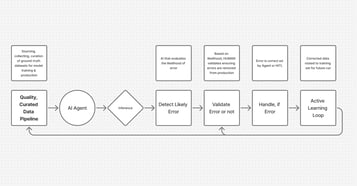
Look across all seven trends and one requirement repeats. Agentic decisions, straight-through claims, imagery prefill, fraud flags, reserve inputs, and regulatory exams all depend on a carrier proving, file by file, that an AI output was right and how it was produced.
Most P&C AI programs don't stall because the model can't read the claim. They stall because no one can show the system is getting more reliable as the book of business changes. In 2026, speed is table stakes. Defensibility is the differentiator.
CloudFactory works with carriers, MGAs, TPAs, and imagery providers on exactly this problem. Our upcoming deep dive explains how carriers make claims and underwriting AI defensible, from the first notice of loss to the regulator's file.
Read the Full Insight Paper: Trusted AI in Property & Casualty Insurance
Frequently asked questions
What are the biggest AI trends in P&C insurance for 2026?
The biggest trends are agentic AI moving into production claims and underwriting, straight-through processing for simple claims, imagery-driven property prefill, AI-based fraud detection against synthetic evidence, AI-assisted casualty reserving, and NAIC examinations of insurer AI systems. Across all of them, measurable and verifiable outcomes now separate leaders from the rest of the market.
How is agentic AI used in P&C claims?
Insurers use AI agents for early-stage claims work such as intake, triage, assignment, and routing, plus pre-bind submission triage in underwriting. Most deploy agents through orchestration layers on top of existing core systems. Because agents take multistep actions, carriers need to evaluate the full decision path, not just the accuracy of a single model.
Why do most P&C AI programs struggle to scale?
Most programs measure accuracy once at launch, then the book of business changes. New document formats, imagery sources, and policy forms degrade performance quietly. Capgemini finds 42% of P&C insurers track no AI metrics, so many carriers can't see whether their AI is improving, holding steady, or drifting.
What is the NAIC AI Systems Evaluation Tool?
It's a structured questionnaire regulators use to inventory an insurer's AI systems, assess governance, and review high-risk models. Twelve states piloted it from March through September 2026, and a revised version is expected to go to the NAIC for adoption in November 2026. It supports market conduct exams and financial examinations.
How are insurers responding to AI-generated claims fraud?
Insurers are deploying image forensics and multisignal fraud detection to catch synthetic or manipulated photos, invoices, and medical documents. Detection alone isn't enough, since flagged volume can outpace investigators. Leading carriers pair AI detection with risk-based routing so human experts review the claims where their judgment changes the outcome.
Key takeaways
- Agentic AI is in production across P&C, but adoption is still shallow and document-focused.
- Only 10% of P&C insurers are scaling AI, and 42% track no AI metrics.
- Straight-through claims, imagery prefill, and fraud detection all depend on knowing which outputs to trust.
- Social inflation makes casualty extraction errors show up years later as adverse reserve development.
- NAIC examinations turn AI governance documentation into an exam-ready requirement.
Data sources
- ISG, Agentic AI Reshapes Property, Casualty Insurance Operations, July 23, 2026
- Datos Insights, AI Implementations in 2026: The Pilot Phase Is Over for Property and Casualty Carriers, 2026
- Capgemini Research Institute, World Property and Casualty Insurance Report 2026, May 5, 2026
- InsurTech Digital, Capgemini Report Flags AI Divide in P&C Insurance Sector, 2026
- WTW, 2026 Advanced Analytics and AI Survey, March 19, 2026
- BCG, The AI-First Property and Casualty Insurer, March 30, 2026
- Artemis, Swiss Re Institute H1 2026 catastrophe loss estimate, 2026
- SAS, Insurers grapple with new fraud threat: AI-generated images, May 2026
- Debevoise & Plimpton, Use of AI-Generated Images for Fake Insurance Claims and Other Frauds, January 20, 2026
- USI Insurance Services, 2026 Commercial Property and Casualty Market Outlook, January 9, 2026
- Milliman, When the past no longer predicts the future: Reserving considerations under social inflation, August 6, 2026
- Monitaur, The NAIC AI Evaluation Tool Pilot Closes in September, August 2026
- Fenwick, NAIC Expands AI Systems Evaluation Tool Pilot Program to 12 States, 2026
- CloudFactory, Trusted AI in Property and Casualty Insurance, October 2026
AI Strategy Finance and Insurance AI & Machine Learning Trusted AI