











Last updated: October 2026
Trusted AI is AI an enterprise can rely on for consequential decisions. Its current performance is measured, every output is traceable, its authority is bounded by defined decision rights, and its errors are detected, corrected, and fed back so they don't recur. Trust is an operating capability, not a certification a model earns once.
Most enterprises treat trust as a gate. A model clears an accuracy target on a curated validation set, a governance committee signs off, and the system goes live. That framing explains why so many programs stall. Deloitte's 2026 State of AI in the Enterprise report found that 25% of respondents have moved 40% or more of their AI experiments into production, and Alteryx's 2026 survey of 1,400 leaders found that only 28% trust AI to support decision-making.
The gap between a working pilot and a system the business relies on isn't a model problem. It's a trust problem.
Trusted AI vs. responsible AI vs. AI governance
These three terms are often used interchangeably, but each describes a different layer of the work.
| Term | What it describes | Typical owner | What it proves |
|---|---|---|---|
| Responsible AI | Principles such as fairness, transparency, and accountability | Ethics, legal, and policy teams | The organization intends to use AI well |
| AI governance | Policies, model inventories, approvals, and controls | Risk and compliance | Rules exist and someone owns them |
| Trusted AI | An operating capability that measures, routes, corrects, and records live AI decisions | Business operations and AI engineering | A specific output, today, can be relied on and defended |
Responsible AI and governance define the standard. Trusted AI is how a production system meets that standard on every decision.
Why AI pilots stall: the trust gap
AI breaks at the seams, not in the model. Three mechanisms keep working pilots out of production.
- Accuracy is measured once, but data changes continuously. A validation score describes performance at launch. Production introduces distribution shift: new document formats, new image sources, new edge cases. Without continuous evaluation, accuracy becomes a historical claim rather than a current fact.
- Uncertainty has nowhere to go. Most deployments return an output with a confidence value and stop there. Uncertain outputs are either accepted silently, which creates hidden errors, or reviewed manually across the board, which erases the business case.
- Corrections don't compound. When an expert overrides a model, that judgment lands in an email, a note, or someone's memory. The model never learns from it.
Scale makes this worse. A model that's right 98% of the time still makes thousands of wrong calls at enterprise volume, and most of those look exactly like the right ones. Data compounds the problem: in a 2026 survey of more than 540 enterprise data leaders, just 8.4% said the data feeding their AI systems was trustworthy enough for production use.
The four properties of trusted AI
Each property is operational, not aspirational, and each can be measured.
1. Known performance
The system is evaluated continuously against a governed evaluation set that reflects real production conditions, including rare cases and degraded inputs. Drift and confidence decay are caught in live production, before a customer, auditor, or regulator catches them.
2. Traceable decisions
For every output, the enterprise can reproduce which input, model version, threshold, and human (if any) produced it. For AI agents, that means tracing multistep reasoning and tool calls, not only the final answer.
3. Bounded authority
Decision rights are defined before autonomy goes live. Some outputs run straight through within guardrails, some require human validation, and some escalate to a named role. The system applies those rules output by output, using calibrated confidence and business risk rather than a single global threshold.
4. Errors that make it better
Every override, escalation, and correction becomes a learning signal. Validated corrections enter the evaluation set and the training set, thresholds update, and the next occurrence is handled correctly without intervention.
The fourth property is the one most deployments lack. It's also what turns the first three from compliance overhead into compounding value.
Trust is a rate, not a threshold
The useful measure for an AI program isn't whether a model is accurate enough to deploy. It's whether the system is getting more reliable every week, and whether the enterprise can prove it.
Production readiness is the rate at which an operation converts exceptions into verified knowledge.
How the trust loop builds trusted AI
CloudFactory builds trusted AI through the trust loop, a continuous cycle that runs on CloudFactory's AI Platform.
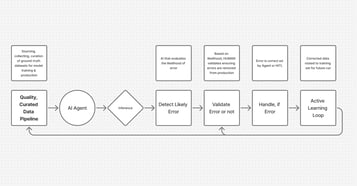
- Automated error detection. AI evaluates your AI against your ontology, policies, and rules to flag low-confidence outputs, edge cases, and likely non-compliance.
- Intelligent routing. The platform sends each flagged item to the CloudFactory Evaluator with the right expertise, weighted by confidence and business risk.
- Validation and remediation. Evaluators confirm whether the issue is genuine, and corrective action is orchestrated through machines or people, whichever fits.
- Continuous feedback. Validated examples enter the evaluation set first and the training set second. Thresholds update, and the knowledge graph grows.
Every output carries a visible confidence state: passed outputs go straight through, outputs in review are routed to a specialist agent or an Evaluator, and held outputs are contained before they reach the business. Human expertise works as a confidence mechanism built into the system, not a labor pool bolted on.
The same pattern runs on physical AI. For Syngenta's Robodog, a four-legged robot running computer vision at the edge, CloudFactory runs model-in-the-loop QA that corrects missing, partial, and misplaced detections. Each correction improves the next prediction.
How to measure whether AI is trustworthy
Replace the single launch accuracy gate with a trajectory. These five metrics show whether trust is compounding:
- Straight-through rate over time: the share of outputs resolved without human touch, tracked weekly.
- Lineage coverage: the share of production outputs with a complete, reproducible decision path.
- Time to resolve flagged outputs: how quickly low-confidence and high-risk outputs are validated inside the live workflow.
- Error recurrence rate: how often a corrected error type appears again.
- Evaluation set growth: how many new production conditions the governed evaluation set covers each month.
Key takeaways
- Trusted AI is an operating capability, not a one-time certification.
- The four properties are known performance, traceable decisions, bounded authority, and errors that make the system better.
- Pilots stall because accuracy is measured once, uncertainty isn't routed, and corrections don't compound.
- The best measure of trust is a trajectory: the rate at which exceptions become verified knowledge.
Glossary
Trusted AI: AI whose current performance is measured, decisions are traceable, authority is bounded, and errors are corrected and fed back into the system.
Trust loop: A continuous cycle of automated error detection, intelligent routing, expert validation and remediation, and feedback into evaluation and training data.
Confidence scoring: Assigning each AI output a calibrated estimate of its likelihood of being correct, used to decide how the output is routed.
Evaluator: A CloudFactory expert who validates flagged AI outputs inside the live workflow.
Distribution shift: A change in production data relative to training data that degrades model performance over time.
See the trust loop running on your workflows at cloudfactory.com.
Data sources
- Deloitte AI Institute, The State of AI in the Enterprise, 2026 AI report, 2026
- Alteryx, From AI Ambition to Impact Report, February 11, 2026
- The Modern Data Company survey, as reported by IT Brief, AI agents outpace trust in enterprise data, survey finds, August 20, 2026
- CloudFactory, Trusted AI at Scale solution brief, 2026