
















Choosing a generative AI provider involves more than comparing feature lists. You need a partner that understands your data, your compliance obligations, and the operational realities of running AI in production. CloudFactory helps enterprise and mid-market teams navigate this evaluation with generative AI services that combine model tuning, continuous oversight, and human-in-the-loop validation.
This article walks you through eight evaluation criteria that separate dependable generative AI providers from those that only look good in a demo. Each factor is grounded in the operational challenges teams face when AI outputs drive real business decisions.
Key takeaways: evaluating generative AI services
- Data quality and governance readiness determine whether a generative AI provider can deliver reliable outputs.
- Domain context signals that a provider understands your regulatory, operational, and data requirements.
- Human-in-the-loop validation is essential for catching the errors that fully automated systems miss in production.
- CloudFactory combines expert Evaluators with model tuning to help teams move AI into production faster.
- Total cost of ownership matters more than license price when evaluating generative AI providers long term.
Evaluation criteria for generative AI providers
1. Data quality and governance readiness
Generative AI models are only as reliable as the data they learn from. Whether your teams handle sensitive customer records, contracts, operational logs, or images, poor governance creates compounding errors. In a 2026 survey of more than 540 enterprise data leaders, 75.9% cited data quality and trust as one of the top three barriers keeping AI agents out of production.
Audit how a provider handles ingestion, validation, and quality control. Ask whether they offer structured data pipelines that turn raw inputs into reliable, AI-ready assets. Providers that treat data preparation as an afterthought will cost you in rework and model drift.
2. Domain context and compliance awareness
Generic AI providers often lack the regulatory and operational awareness that high-consequence workflows demand. Depending on your business, models may need to align with data privacy rules, industry regulations, or internal risk policies, and small accuracy gaps can directly affect margins, customers, or safety.
Evaluate whether a provider has delivered projects with requirements similar to yours. Ask for documented case studies, client references, and compliance certifications that match your obligations. A provider that understands your context will anticipate your edge cases rather than discovering them after deployment.
3. Human-in-the-loop validation capabilities
Automation alone doesn't guarantee accuracy in high-stakes environments. Generative AI outputs that feed financial, operational, or customer-facing decisions need expert validation at critical points. CloudFactory delivers human-in-the-loop solutions through CloudFactory Evaluators trained for each project, catching errors that automated quality checks miss.
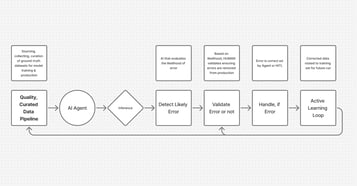
When evaluating providers, look for structured oversight workflows where low-confidence outputs are routed to qualified Evaluators who validate and correct them before they reach production. This layer of human accountability separates reliable AI operations from those that accumulate undetected errors over time.
4. Model tuning and customization depth
Off-the-shelf generative models rarely perform well enough on specialized tasks without tuning. You need a provider that offers model customization through techniques like reinforcement learning from human feedback (RLHF), prompt engineering, and embeddings retrieval. These approaches align model behavior with your terminology, risk thresholds, and operational context.
Ask providers to demonstrate their tuning methodology. A credible partner will walk you through named stages of their process, from initial analysis and seed data preparation to iterative training rounds and production-readiness validation.
5. Scalability without sacrificing quality
Many teams start with a focused pilot and then need to scale quickly. The challenge is maintaining data accuracy and model performance as volumes grow. Look for providers that pair technology with dedicated, managed expert teams, so scaling up doesn't mean accepting lower-quality outputs or opaque contributor pools.
CloudFactory addresses this by training dedicated teams through structured onboarding, then managing quality assurance and quality control at every stage. Confidence scoring concentrates human effort on the outputs that need it, so throughput grows without the accuracy loss that often comes with rapid scaling through anonymous crowdsourcing platforms.
6. Integration with your existing infrastructure
A generative AI provider should work with your current stack, not require a full replatforming effort. Teams running AI alongside existing data pipelines, systems of record, and workflow tools need providers that support API-driven integration and work with tools already in production.
Evaluate whether the provider offers documented APIs, SDK access, and the flexibility to connect with your cloud environment. CloudFactory's AI Platform supports integration across multiple model providers and data sources, reducing the overhead of adopting a new generative AI capability.
7. Transparent cost structure and total cost of ownership
Sticker price rarely tells the full story. Evaluate providers on total cost of ownership, including data preparation, model training iterations, ongoing monitoring, and human validation cycles. Understanding where your budget goes is critical as AI investments grow.
Request a detailed cost breakdown that covers setup, recurring model monitoring, retraining triggers, and expert capacity as volumes scale. Providers that offer a subscription-based model with predictable pricing help you plan budgets without surprise overages.
8. Post-deployment monitoring and governance
Deploying a generative AI model isn't the finish line. Models drift, data distributions shift, and regulatory requirements evolve. You need a provider that delivers continuous model oversight, including automated performance tracking, alerting on accuracy degradation, and structured retraining workflows.
Ask how the provider handles model governance in production. Look for audit logging, full decision lineage, compliance reporting, and human-in-the-loop escalation for low-confidence predictions. CloudFactory combines automated monitoring with expert validation, and every correction feeds back into evaluation and training data, so AI reliability improves long after initial deployment.
How to choose the right generative AI partner for your workflows
Evaluating generative AI providers requires looking beyond demos and feature comparison charts. The eight criteria above give you a structured framework for assessing whether a provider can deliver reliable, compliant, and scalable AI within your operations.
Start by mapping your most pressing operational bottlenecks to specific provider capabilities. Prioritize partners that understand your domain, offer transparent pricing, and maintain quality through expert oversight at every stage.
CloudFactory helps teams move from AI experimentation to production-ready deployment with model tuning, continuous oversight, and expert validation built into the workflow. If you're evaluating generative AI providers, we'd welcome the opportunity to walk through your requirements.
>> Learn More About: CloudFactory's Trusted AI at Scale
FAQs about generative AI services
What are generative AI services?
Generative AI services help organizations build, fine-tune, and deploy AI models that produce new content or decisions from learned patterns. These services typically include data preparation, model training, prompt engineering, and ongoing monitoring to keep outputs accurate and relevant to your business context.
Why is domain context important when choosing a generative AI provider?
Domain context ensures your provider understands the regulatory, operational, and data requirements specific to your business. A provider experienced with high-consequence workflows already knows how to handle compliance requirements, sensitive data, and costly edge cases without starting from scratch.
How does human-in-the-loop validation improve generative AI accuracy?
Human-in-the-loop validation routes low-confidence outputs to expert Evaluators at critical decision points to catch errors, correct model outputs, and provide feedback that improves future performance. This approach is especially valuable wherever a single incorrect output can have significant financial, operational, or regulatory consequences.
What should companies budget for generative AI implementation?
Budgets vary based on scope, but companies should account for data preparation, model training, integration, ongoing monitoring, and human validation costs. Evaluating total cost of ownership rather than license price alone helps you avoid unexpected expenses during scaling.
How do you evaluate the scalability of a generative AI provider?
Assess whether the provider can increase data processing volume and expert capacity without degrading output quality. Look for structured scaling processes, dedicated team training programs, and quality assurance frameworks that maintain accuracy as your needs grow.
What role does model monitoring play after deploying generative AI?
Model monitoring tracks performance, detects accuracy degradation, and triggers retraining when outputs fall below acceptable thresholds. Without continuous monitoring, generative AI models can drift from their intended behavior, producing unreliable results that erode trust and create operational risk.
Data sources
- The Modern Data Company survey, as reported by IT Brief, AI agents outpace trust in enterprise data, survey finds, August 20, 2026