.png?width=485&height=87&name=cf-logo-blue-transparent%20(1).png "cf-logo-blue-transparent (1)")
.png?width=1563&height=1563&name=Untitled%20design%20(38).png)







.png?width=1563&height=1563&name=Untitled%20design%20(33).png)


.png?width=1563&height=1563&name=Untitled%20design%20(34).png)







Ethical AI isn't built at the end of a project; it's built into it. From the first data you acquire to the system running live in production, every stage carries choices about bias, privacy, and accountability that shape how ethical the final model is.
Why Ethics Matters More Than Ever:
A CloudFactory sponsored survey found that 94% of AI leaders believe AI is biased. This is a striking admission from the people building it, and a clear signal that ethics can't be left to chance. When nearly everyone agrees bias is real, ethics stops being a philosophical nice-to-have and becomes a practical necessity. A problem introduced at the data stage follows the model everywhere, and no amount of clever tuning at the end scrubs it back out. Most teams only address ethics in the last few steps, when they're validating and tuning a model that already works. By then it is far too late. The only question left is whether you design against bias from the start or pay to re-engineer it out later.
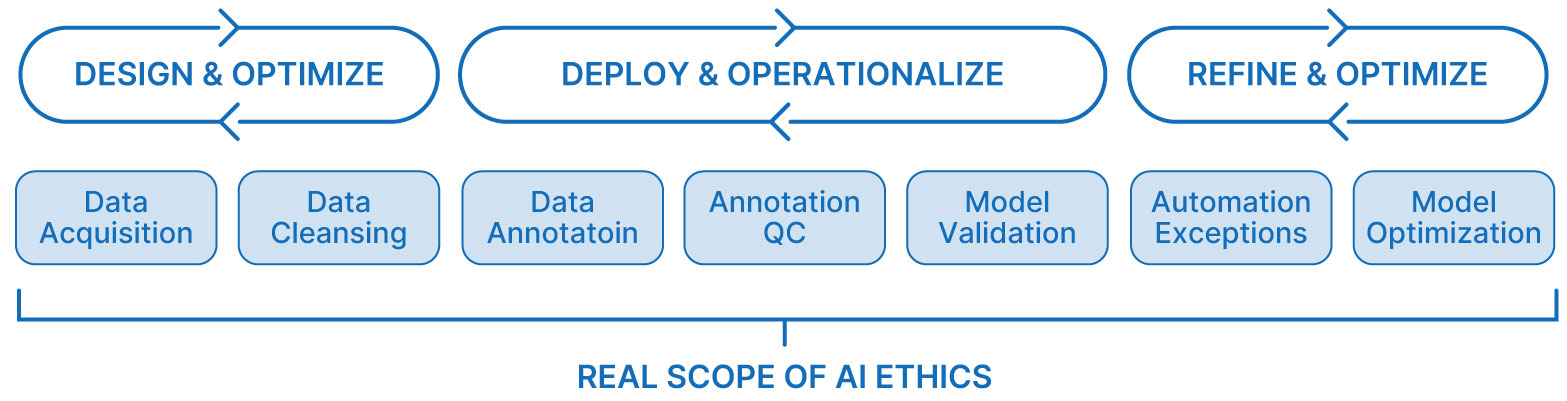
The solution is integrating ethics into every step of the process. AI development falls into three phases: design and build, deploy and operationalize, and refine and optimize. Ethics should be prioritized spanning from data acquisition to watching the model in production.
Bias Starts With Your Data:
The fastest route to an unethical model is convenient data. Lets use US healthcare as an example: easy to access, but loaded with decades of demographic bias. A model trained on uncleaned historical data will produce biased predictions, no matter how well-engineered the model is.
Autonomous vehicles make this point vivid. Most AV training data comes from exclusively urban areas and western roads. Therefore, a car dropped onto a rural lane with no markings, a tractor hanging into the lane, the occasional chicken, or into the middle of Mumbai has no idea what to do. In fact, in AAA's 2022 closed-course testing of driver-assistance systems, vehicles struck a crossing cyclist in a third of test runs because they had not been trained on enough edge cases. That isn’t a tuning problem. It’s a data problem.
There is a legal side too. Generative models can produce near-copies, sometimes exact copies, of existing work. In 2025, Anthropic paid $1.5 billion to settle authors' claims that its models were trained on pirated books. With more cases still moving through the courts, the rules on what's fair to use for training are far from settled.
The Myth of Anonymized Data:
Stripping names out of a data set doesn't make it anonymous. Three ordinary fields from a credit application, a partial UK postcode, a date of birth, and gender, give a 75% chance of picking out one specific person in a supposedly cleaned data set (Rocher et al., Nature Communications, 2019). Adding employment status pushes that to 89% (Rocher et al., 2019). Researchers have also re-identified people from supposedly anonymous Bluetooth contact-tracing data more than half the time.
There are three problems at once: ethical, legal, and technical. GDPR bans identifying people without explicit permission, carries fines up to 4% of global revenue, and reaches any company that touches European data. Identifying individuals doesn't only create legal exposure, it's a shortcut to overfitting, too. Yet these three problems are almost never discussed as the single, connected issue they are.
Four Steps to Build More Ethical AI:
1. Be Aware From The Start
The Open Data Institute’s Data Ethics Canvas works for any data project, not only AI. Be honest about the downsides (even a perfect self-driving car puts drivers out of work), and lean on frameworks like the Alan Turing Institute’s Project ExplAIn and Google’s Responsible AI framework. Diverse teams matter, since people from similar backgrounds share the same blind spots. Regulation is coming too: The EU's AI Act now carries fines of up to 7% of global turnover, a higher ceiling than GDPR.
2. Build Your Own Data Sets
Convenience data sets skew Western. Labeled Faces in the Wild, a widely used set, is roughly 78% male and 83% white, nothing close to the actual population. The sensible path is to use an easy data set to prove the idea works, then build or curate a dedicated one before production.
3. Get the Annotation Strategy Right
The “more data is always better” instinct gets a useful reality check. Bad data hits the ceiling fast. An active-learning approach, where the system surfaces the examples it’s most confused about, can reach the same accuracy with up to 80% less labeled data, a real saving in time and cost.
4. Keep Humans in the Loop
One example: a model that’s 70% confident a statue of a Newfoundland dog is a bird. Confident, and wrong. Rather than discarding the low-confidence predictions a model makes in production, feed those edge cases back into training. Watch for model drift as the world shifts under the model, and treat explainable AI as a helper for human oversight, not a replacement for it.
Key Takeaways
- Ethics is a lifecycle concern, not a final tweak. What breaks at the data stage follows everything downstream.
- Convenient and historical data carries bias. Diversify sources and build dedicated data before shipping.
- Taking names out doesn’t make data anonymous. Proxy variables and re-identification are real legal and modeling risks.
- Active learning beats hoarding more data, and humans in the loop catch the confident mistakes a model misses.
Build Trustworthy AI on Trustworthy Data
Ethical AI comes down to the unglamorous work of sourcing, labeling, and checking data. Trustworthy AI starts with trustworthy data, and trustworthy data needs skilled people. That's why CloudFactory's data analysts work throughout the lifecycle, catching problems before they reach production.
Watch the on-demand recording of Ethically Designed AI Systems and see the full session. To talk through what ethical AI looks like for your team, connect with CloudFactory